- Gruppe
- Sovcali
- Erfassungsdatum
- Status
- Online / unverändert
Hinweise zur Einordnung
Dieser Eintrag dokumentiert eine Veröffentlichung der Gruppe. Ein Angriff oder Datenabfluss ist damit nicht unabhängig bestätigt.
- Land: nicht verfügbar
- Branche: nicht verfügbar
Konfidenz ist eine heuristische Einschätzung. Prüfzeitpunkte beziehen sich auf die Anreicherung, nicht auf unabhängige Verifikation. Herkunft und Korrekturen finden Sie unter „Firmeninformationen & Datenherkunft“.
Angaben der Ransomware-Gruppe
UnbestätigtQuellentext als öffentliche Metadaten wiedergegeben. Die Aussagen wurden nicht unabhängig geprüft; Links sind ausgeblendet.
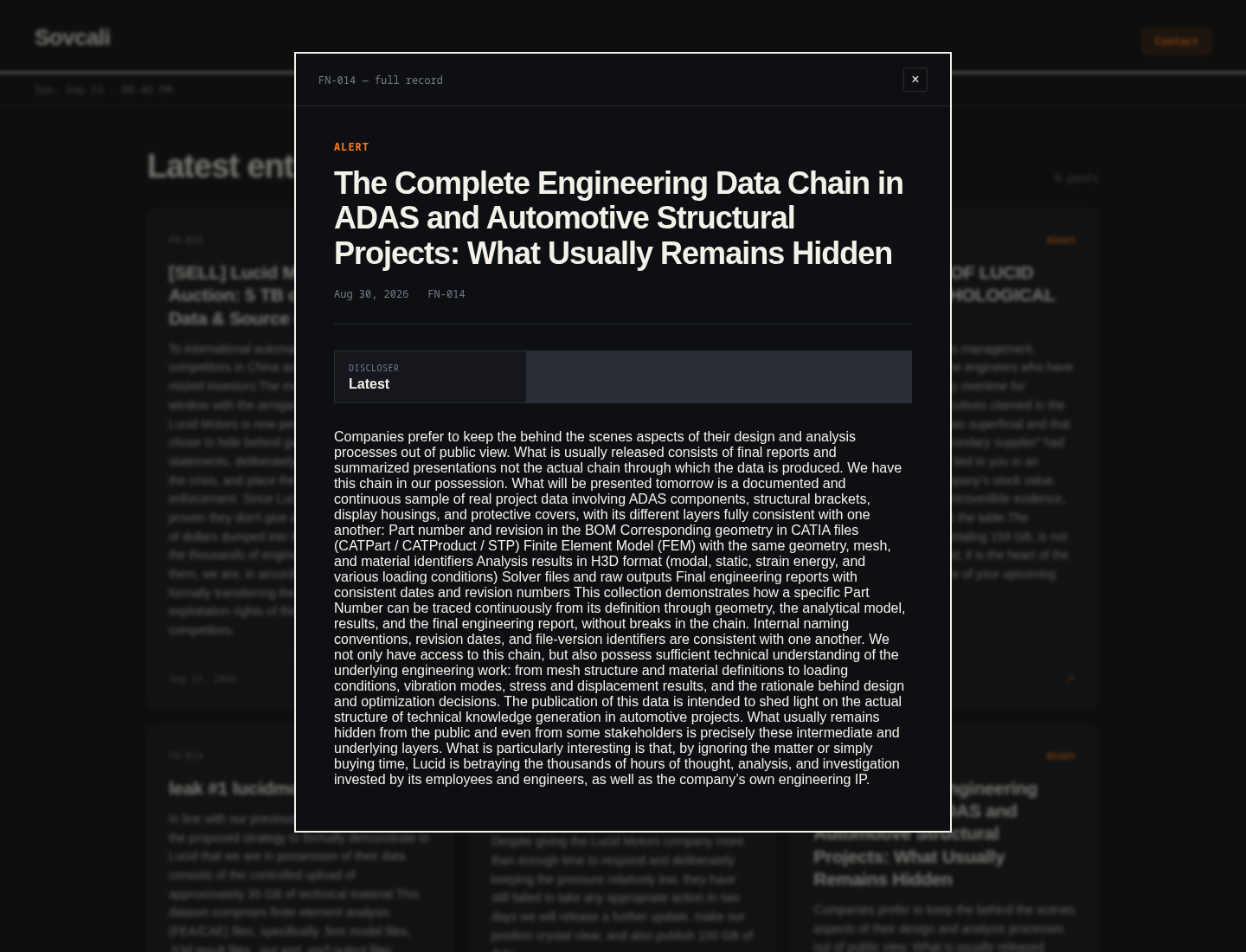
The Complete Engineering Data Chain in ADAS and Automotive Structural Projects: What Usually Remains Hidden
Companies prefer to keep the behind the scenes aspects of their design and analysis processes out of public view. What is usually released consists of final reports and summarized presentations not the actual chain through which the data is produced.
Companies prefer to keep the behind the scenes aspects of their design and analysis processes out of public view. What is usually released consists of final reports and summarized presentations not the actual chain through which the data is produced.
We have this chain in our possession.
What will be presented tomorrow is a documented and continuous sample of real project data involving ADAS components, structural brackets, display housings, and protective covers, with its different layers fully consistent with one another:
Part number and revision in the BOM
Corresponding geometry in CATIA files (CATPart / CATProduct / STP)
Finite Element Model (FEM) with the same geometry, mesh, and material identifiers
Analysis results in H3D format (modal, static, strain energy, and various loading conditions)
Solver files and raw outputs
Final engineering reports with consistent dates and revision numbers
This collection demonstrates how a specific Part Number can be traced continuously from its definition through geometry, the analytical model, results, and the final engineering report, without breaks in the chain. Internal naming conventions, revision dates, and file-version identifiers are consistent with one another.
We not only have access to this chain, but also possess sufficient technical understanding of the underlying engineering work: from mesh structure and material definitions to loading conditions, vibration modes, stress and displacement results, and the rationale behind design and optimization decisions.
The publication of this data is intended to shed light on the actual structure of technical knowledge generation in automotive projects. What usually remains hidden from the public and even from some stakeholders is precisely these intermediate and underlying layers.
What is particularly interesting is that, by ignoring the matter or simply buying time, Lucid is betraying the thousands of hours of thought, analysis, and investigation invested by its employees and engineers, as well as the company’s own engineering IP.