- Gruppe
- Lamashtu
- Erfassungsdatum
- Status
- Online / unverändert
Hinweise zur Einordnung
Dieser Eintrag dokumentiert eine Veröffentlichung der Gruppe. Ein Angriff oder Datenabfluss ist damit nicht unabhängig bestätigt.
- Land: nicht verfügbar
- Branche: geringe Konfidenz
Konfidenz ist eine heuristische Einschätzung. Prüfzeitpunkte beziehen sich auf die Anreicherung, nicht auf unabhängige Verifikation. Herkunft und Korrekturen finden Sie unter „Firmeninformationen & Datenherkunft“.
Angaben der Ransomware-Gruppe
UnbestätigtQuellentext als öffentliche Metadaten wiedergegeben. Die Aussagen wurden nicht unabhängig geprüft; Links sind ausgeblendet.
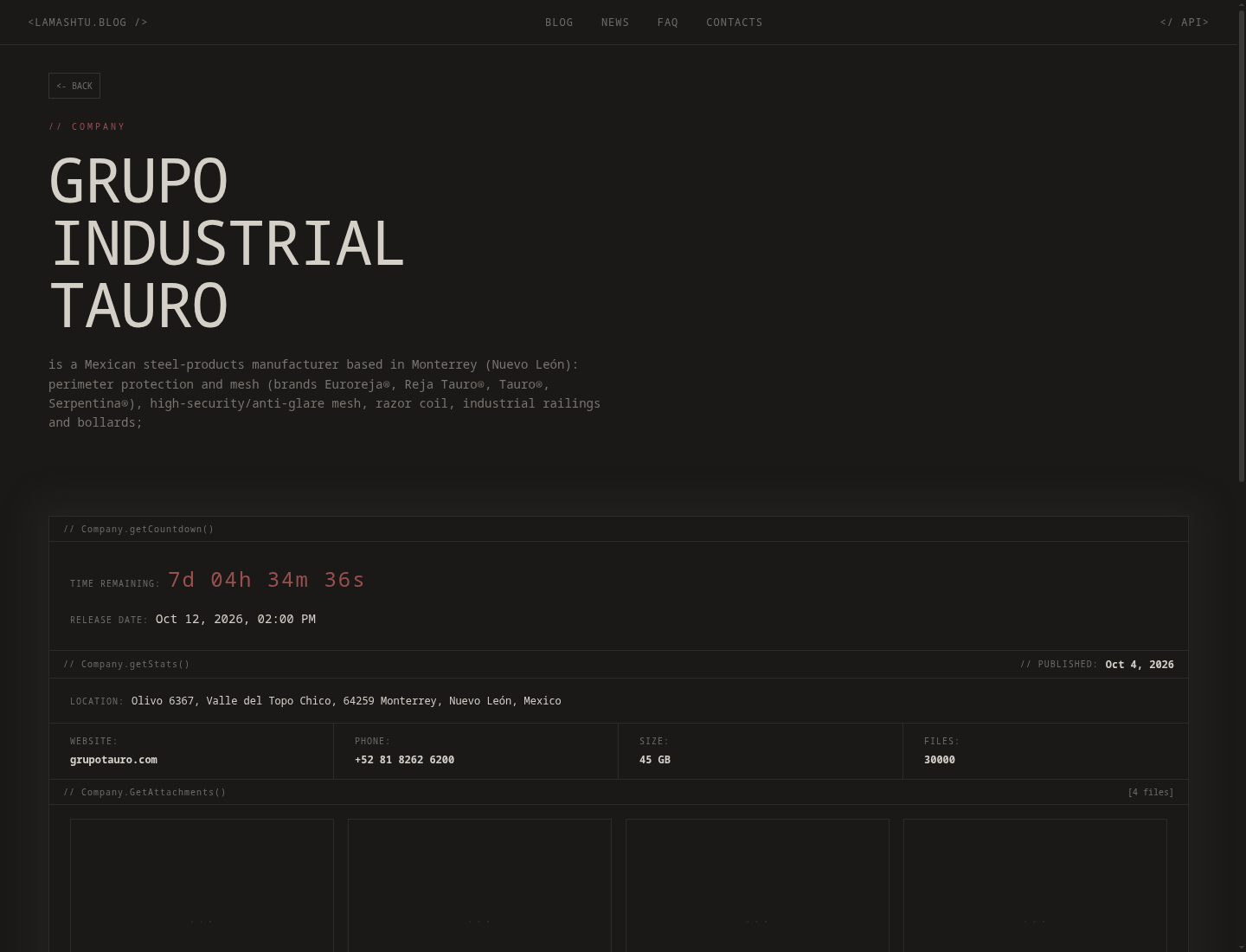
is a Mexican steel-products manufacturer based in Monterrey (Nuevo León): perimeter protection and mesh (brands Euroreja®, Reja Tauro®, Tauro®, Serpentina®), high-security/anti-glare mesh, razor coil, industrial railings and bollards;
SUMMARY
We obtained the complete internal file repository of Grupo Industrial Tauro , a Mexican manufacturing company. The dataset contains tens of thousands of files spanning from 2021 through 2026, extracted from their internal server. The archive includes complete accounting records, tax compliance documentation, employee personal identification, and cryptographic keys for government systems.
The breadth of the dataset covers every operational area: financial records, audit reports, tax filings, human resources documentation, and digital certificates for SAT, IMSS, and INFONAVItelectronic signatures. The presence of active FIEL private keys and CSD certificates means the ability to file taxes, sign documents, and conduct official transactions in the company's name.
WHAT WE HAVE
Personal Data
The dataset contains identity documents for multiple individuals associated with the organization. We have INE (voter credential) scans showing both front and back, CURP certificates, birth certificates, and passport images. These documents enable identity verification and can be used to construct complete profiles.
Specific individuals have been identified by name through their documentation.
Additionally, salary information and debt records are present, exposing compensation details and personal financial obligations.
Financial Records
The accounting archive is extensive. We have tens of thousands of CFDI files—Mexico's digital tax receipt format—along with corresponding PDF invoices. Monthly financial statements, commission calculations, and unit-level results are organized by year and period.
The dataset includes:
Complete CFDI XML tax receipts with PAC signatures
Monthly income statements by business unit
Commission and salary spreadsheets
Bank account documentation
Amortization schedules
Debt tracking records
Tax & Government Compliance
The organization maintains comprehensive tax compliance documentation. We have constancias de situación fiscal (tax status certificates), positive opinions from SAT, IMSS, and INFONAVIT, and monthly compliance records organized chronologically.
These documents demonstrate the company's regulatory standing and contain official stamps and validation codes.
Digital Keys & Certificates
The most sensitive technical finding is the presence of active cryptographic credentials:
FIEL private keys ( Claveprivada_FIEL_*.key ) — Mexico's equivalent of a digital tax ID, used for filing returns, signing contracts, and government transactions
CSD keys (Certificado de Sello Digital) — used to generate valid CFDI invoices
IMSS signing keys — for social security portal authentication
PFX certificate bundles — containing both keys and certificates
Password files ( [Link entfernt] ) — plaintext credentials for certificate unlocking
VPN configuration files ( .ovpn ) — network access credentials
These keys combined with their password files provide the ability to authenticate as the company across multiple government portals.
Legal Documents
Notarial powers of attorney are present, including specific authorizations for company representatives. Administrative disciplinary records and birth certificates round out the legal documentation.
Audit & Operations
Monthly global inventory reports span multiple years. Quality control inspection logs track raw material receipt and processing. Maintenance schedules and budget tracking documents show operational planning.
WHO CAN RECEIVE THIS DATA
Regulators
Mexico's INAI (Instituto Nacional de Transparencia, Acceso a la Información y Protección de Datos Personales) has jurisdiction over personal data protection. The presence of employee INE credentials, CURP records, and salary information constitutes a reportable breach under Mexican data protection law.
SAT (Servicio de Administración Tributaria) would be interested in the exposure of FIEL keys and CSD certificates—these credentials enable tax filing and invoice generation. The compromise of these keys could affect the integrity of the tax system.
IMSS and INFONAVIT credentials in the dataset provide access to social security and housing fund portals, where employee contributions and benefits are managed.
Individuals
People whose INE, CURP, passport, and financial documents appear in this dataset can be contacted directly. They have a right to know their identity documents are exposed and that their salary and debt information has been compromised.
Competitors
The financial statements by business unit, client lists, quotation templates, and export certification documents provide competitive intelligence. Manufacturing companies in the same sector would find value in understanding pricing, margins, and customer relationships.
Media
A Mexican manufacturing company losing its tax signing keys, employee identity documents, and complete financial records presents a clear story. The exposure of FIEL credentials—essentially the company's digital identity for all government transactions—distinguishes this breach from typical data leaks.
WHAT CAN HAPPEN
The FIEL private keys can be used to file tax returns, sign contracts, and conduct official transactions as the company
CSD certificates enable generation of valid CFDI invoices that would appear legitimate in the SAT system
Employee identity documents can be used for fraud, account opening, or impersonation
Salary and debt information exposes individuals to targeted social engineering or extortion
VPN configuration files can provide network access to internal systems
Financial records reveal business unit performance, margins, and client relationships
Compliance documents show regulatory standing and can be used to understand audit patterns
The complete dataset can be published and indexed, appearing in due diligence searches indefinitely
Once distributed, this data can be repackaged and traded among other threat actors, fraud groups, and competitors—each using it independently for their own purposes