- Gruppe
- Lamashtu
- Erfassungsdatum
- Status
- Online / unverändert
- Land
- Deutschland
Hinweise zur Einordnung
Dieser Eintrag dokumentiert eine Veröffentlichung der Gruppe. Ein Angriff oder Datenabfluss ist damit nicht unabhängig bestätigt.
- Branche: geringe Konfidenz
Konfidenz ist eine heuristische Einschätzung. Prüfzeitpunkte beziehen sich auf die Anreicherung, nicht auf unabhängige Verifikation. Herkunft und Korrekturen finden Sie unter „Firmeninformationen & Datenherkunft“.
Angaben der Ransomware-Gruppe
UnbestätigtQuellentext als öffentliche Metadaten wiedergegeben. Die Aussagen wurden nicht unabhängig geprüft; Links sind ausgeblendet.
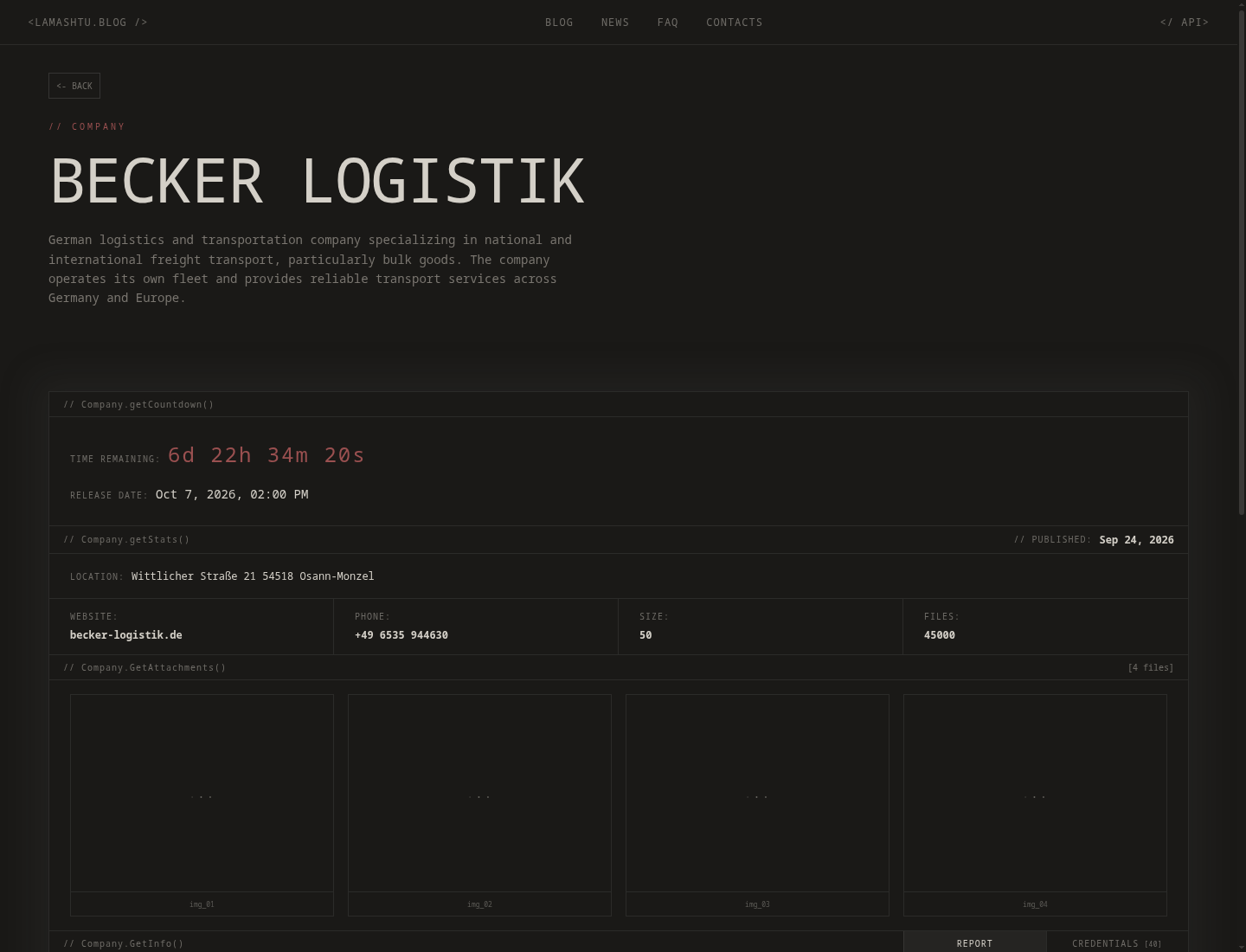
German logistics and transportation company specializing in national and international freight transport, particularly bulk goods. The company operates its own fleet and provides reliable transport services across Germany and Europe.
SUMMARY
We obtained the complete file archive of a logistics and transportation company operating from the Aachen region. The dataset spans tens of thousands of files covering the period from 2020 through 2026, with the bulk of materials from 2021 onward. The archive was taken from a single internal file server and includes the full breadth of the organization's administrative operations.
The data covers human resources, payroll, accounting, fleet management, legal proceedings, real estate holdings, and banking relationships. Employee personnel files, driver records, tax documentation, vehicle registrations, and financial correspondence are all present. The archive also contains credential stores and VPN configuration files.
The scope is broad: several thousand personnel files, several thousand invoice and billing records, over a thousand administrative offense files tied to named drivers, and hundreds of tax and banking documents. The dataset has been fully catalogued and indexed.
This breach occurs in a climate where major German data incidents have already drawn significant public and regulatory attention. Recent publications on large-scale German data leaks demonstrate how quickly stolen archives are analyzed, categorized, and surfaced by journalists and researchers ( [Link entfernt] , [Link entfernt] , [Link entfernt] ).
WHAT WE HAVE
Personal Data
The dataset contains several thousand personnel files covering both current and former employees. These include employment contracts, personal questionnaires, tax identification applications, payroll tax certificates, and correspondence with health insurance providers. Files for departed employees include termination documents, final payroll settlements, and insurance deregistration confirmations.
Over a thousand employee-related files cover the driver workforce specifically. These include:
Employment records and driver qualification files
Administrative offense records tied to individual drivers, with case numbers, vehicle identifiers, and correspondence with authorities
COVID-19 employer declarations and sworn statements for cross-border drivers
Forklift training certificates and annual refresher documentation
Driver card documents and dispatch certificates for employees posted to France
The personnel files include tax identification numbers, insurance registration data, and signed employment contracts. This provides everything needed to impersonate employees in interactions with tax authorities, insurance providers, and social security agencies.
Over a hundred application files are present, covering job applicants for positions at the organization. These include application documents, internship and trainee records, and correspondence related to hiring processes.
Financial Records
The financial documentation in this dataset is extensive. Several thousand invoice and billing records are present, including outgoing invoices, supplier invoices, and accounting export files in CSV format. Monthly payroll records cover multiple years, with timesheets and payroll overviews for the entire workforce.
Hundreds of VAT-related files are included:
Monthly VAT advance returns and supporting bank statement extracts
Annual VAT declarations and tax assessment notices
Mineral oil tax refund documentation spanning multiple years
Hundreds of tax assessment notices cover vehicle taxes, property taxes, and corporate tax obligations. Over a hundred DATEV accounting export files are present, along with cash books, bank statements, and SEPA mandate documents.
Financing documents for fleet vehicles include signed loan agreements, interest rate adjustment notices, and security release confirmations. Bank correspondence with the organization's banking partners includes balance sheet submissions, online banking documentation, and powers of attorney.
Over a hundred files relate to company pension schemes, and over a hundred cover loan and credit arrangements. Provisions and balance sheet documents are also present.
Legal & Compliance
Over a thousand administrative offense files are included, covering traffic violations and regulatory infractions by the organization's drivers. These files contain:
Case reference numbers and administrative file identifiers
Witness questionnaires with named individuals
Hearing documents and fine notices
Case dismissal notifications
Correspondence with prosecuting authorities
Several thousand files matched to witness and expert assessment categories include vehicle damage reports, expert appraisals, insurance claim documentation, and salvage invoices. These cover fleet incidents with photographs, damage assessments, and settlement correspondence.
Administrative offense files contain case numbers, names, addresses, specific allegations, amounts, and the official language used in prior correspondence with the affected individuals. This provides a complete template for impersonating authorities in fraudulent communications — a pattern already observed in other German data breaches where leaked fine records were used to craft convincing fake notices ( [Link entfernt] ).
Over a hundred termination documents are present, covering both employee resignations and dismissals.
Fleet & Operations
The dataset includes comprehensive fleet management documentation. Over a hundred TÜV inspection certificates cover trucks, trailers, and industrial equipment including loading dock doors. Vehicle registration documents for the entire fleet are present, including registration certificates for multiple trucks and trailers.
Fleet-related files include:
Vehicle tax assessments and payment records for individual vehicles
Service, maintenance, and repair invoices with diagnostic details
Financing offers and signed loan agreements for individual vehicles
Damage reports with photographs and expert appraisals
Fuel card and mineral oil tax refund documentation
Loading equipment management records include exchange receipts and delivery confirmations for pallets and loading materials across multiple logistics partners.
Real Estate & Property
The dataset includes property documentation for real estate holdings, including rental contracts, utility billing records, and operating cost settlements for residential units. Property tax assessment notices, land value determinations, and SEPA mandates for property-related payments are present.
Energy supply documentation and operating cost allocations for individual rental units are included, along with correspondence related to property tax assessments spanning multiple years.
Credentials & Access
Over a hundred files related to access credentials are present in the dataset. KeePass password database files ( .kdbx ) were extracted, along with OpenVPN configuration files ( .ovpn ). These files may provide access to internal systems, VPN endpoints, and stored credentials for third-party services.
The dataset has been fully processed and documented. Every component of the breach has been mapped.
WHO CAN RECEIVE THIS DATA
Regulators
Under the GDPR, German data protection authorities have jurisdiction over this breach. The dataset contains personal data of employees, former employees, and job applicants — including tax identification numbers, insurance data, employment contracts, and administrative offense records. The presence of health insurance correspondence and COVID-19 declarations adds another dimension of sensitivity.
Regulators can be notified directly with a structured summary of the exposed data categories. The volume of personal records and the inclusion of special category data (health insurance, tax IDs) create clear reporting obligations under GDPR.
Individuals
The personnel files, driver records, and application documents contain names, addresses, tax identification numbers, and employment details. Affected individuals can be contacted directly with specific information about what data of theirs was exposed.
Former employees are particularly exposed — their departure files include termination documents, final tax certificates, and insurance deregistration data. Job applicants who were never hired still have their application materials in the archive.
Competitors
The financial and operational data in this dataset provides competitors with detailed insight into the organization's cost structure. Fleet financing terms, payroll levels, supplier pricing, accounting records, and real estate holdings are all present. The DATEV exports and accounting files reveal revenue patterns, cost allocations, and provisioning decisions.
Competitors can use this information to undercut pricing, target the organization's drivers with better offers based on known salary data, and identify which suppliers and logistics partners the organization relies on.
Media
The combination of employee personal data, administrative offense records, and financial documentation provides multiple angles for journalistic investigation. As demonstrated by recent coverage of German data breaches, published data gets systematically analyzed by reporters who cross-reference file contents with public records ( [Link entfernt] , [Link entfernt] ).
Published breach data surfaces during due diligence searches for years. Once indexed, it becomes a permanent reference point for anyone researching the organization.
WHAT CAN HAPPEN
The full archive can be published on a leak site, making all personnel files, financial records, and legal documentation publicly accessible
Regulators can receive a structured notification with evidence of exposed personal data categories, triggering formal investigation proceedings
Affected individuals can be contacted directly with details of their exposed data, including tax IDs, employment terms, and administrative offense records
Credential stores and VPN configurations can be used to attempt access to internal systems and third-party services
Financial documents can be used to craft targeted fraud schemes impersonating the organization's banking partners or tax authorities
Administrative offense files can be used to create convincing fake fine notices with real case numbers, names, and official language
Competitors can analyze the financial and operational data to understand pricing, payroll, and supplier relationships
The dataset can be indexed, traded, and repackaged by other threat actors independently — this is not a single event but permanent exposure of every file in the archive